
The capital must be lawfully earned and fully traceable, from its origin to the project account.
The funds must be genuinely at risk in the business. By law, EB-5 capital cannot be guaranteed.
The business must create the jobs the program requires — at least 10 full-time positions per investor.
Form I-526E. This petition asks USCIS to confirm the investment and the project meet EB-5 requirements.
Over the conditional period, the enterprise must create at least 10 full-time jobs per investor.
Form I-829. Near the end of the two years, the investor files to prove the investment was sustained and the jobs were created. On approval, the conditions are removed and the green card becomes permanent.
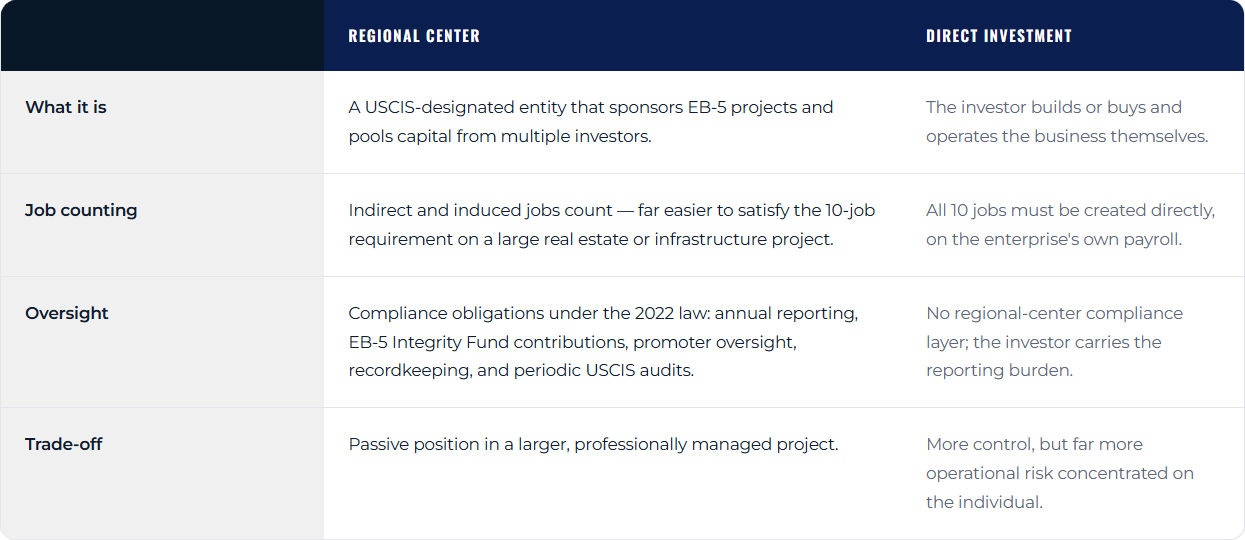
All 10 jobs must be actual W-2 positions on the enterprise’s own payroll.
A green card valid for two years, issued after the I-526E is approved and a visa is available.
Granted after the investor files Form I-829 and proves the investment was sustained and the jobs were created.
EB-5 is frequently used by professionals already in the U.S. on temporary visas — including H-1B, F-1 OPT, L-1, and O-1 — who want a residency path that does not depend on an employer or the H-1B lottery.
Offerings from private issuers in the U.S. are generally available only to accredited investors, and accredited-investor status is verified before investment.
The minimum is $800,000 for a project in a Targeted Employment Area or qualifying infrastructure project, or $1,050,000 for a standard-location project, plus separate government, legal, and administration fees. These amounts are scheduled to adjust for inflation on January 1, 2027.
At least 10 full-time jobs for qualifying U.S. workers. Through a regional center, up to 90% of those may be indirect or induced jobs estimated with accepted economic models.
Yes. The investor, their spouse, and unmarried children under 21 are eligible, subject to USCIS petition approval and individual eligibility.
Many investors do. If a visa is available, the RIA also allows eligible applicants in the U.S. to file for a work permit (I-765) concurrently with the I-526E. Timing is case-specific — consult your immigration attorney.
A rural area — outside a Metropolitan Statistical Area and outside any city or town of 20,000 or more — or a high-unemployment area, where unemployment is at least 150% of the national average. A TEA project qualifies at the lower $800,000 minimum.
No. By law, EB-5 capital must be at risk, so no guarantee of return, repayment, or immigration outcome is permitted. Evaluate every project on its risk profile and structure.
The I-526E is your initial investor petition that leads to a two-year conditional green card. The I-829 is filed near the end of those two years to prove the investment and jobs, remove the conditions, and obtain permanent residence.
Filing your I-526E on or before that date grandfathers you into current rules and locks in today’s investment amount ahead of the scheduled January 1, 2027 increase.
For accredited investors only. This is not an offer to sell securities; any offer is made solely through the Confidential Private Placement Memorandum. EB-5 investments involve substantial risk, including loss of capital and denial of immigration benefits. No guarantee of immigration or investment outcomes. Consult independent immigration counsel and qualified financial advisors before investing.